
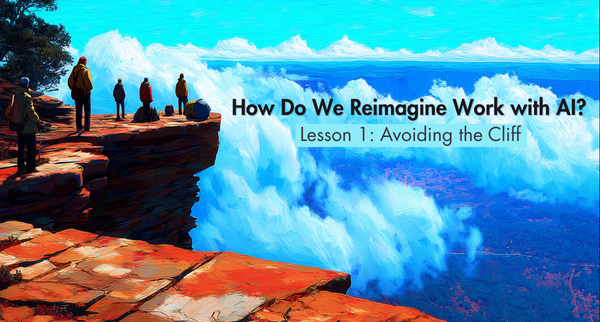
Picture this: you’re standing at the edge of a cliff. The clouds below are soft, almost inviting, but you can’t tell if they’ll hold you — or if you’ll fall straight through. That’s where we are in the workplace today.
The headlines suggest that the crisis is centered on AI automation and job losses. But that’s only the surface. The deeper truth is this: the crisis is the predictable outcome of a society that has shifted its expectations, and of individuals straining to navigate a modern world that feels like it’s accelerating beyond control.
Work has been shifting for a very long time. The Industrial Age, the Computer Age, the Information Age: each reshaped how we live and provide for our families. Now we’ve entered the Age of Artificial Intelligence, a natural extension of our digital immersion. And like Hemingway said of bankruptcy, AI came “gradually, then suddenly.”
The Promise and the Fear
For business leaders, AI offers profit and efficiency. For employees, the hope is more creativity and productivity among their teams. But the adoption of AI isn’t as simple as flipping a switch.
If the media is to be believed, AI will wipe out jobs, spark mass unemployment, and deepen dissatisfaction. For companies, the promise is higher profits, but only if adoption unfolds without wasting precious time and money.
The difference from past transformations is speed. Electricity took decades to reshape the workplace. AI has taken months, sometimes weeks. Gradually, then suddenly, it has become a truth and a crisis.
The Electricity Lesson

When electricity entered the workplace, leaders faced a choice: plug it in, or reimagine their operations. Henry Ford, who once worked for Edison, saw what electricity could do. But he also knew he couldn’t just bolt it onto old ways of working.
Factories had to be torn apart and rebuilt. Equipment repositioned. Entire workflows redesigned. And critically, leaders themselves had to learn how electricity worked — not to become engineers, but to understand enough to strategize and innovate.
That’s where we are with AI today. Leaders can’t delegate it to IT or tuck it in a corner of the org chart. They must learn alongside their teams, rethinking not just tools but the very structure of work.
Generations in Transition
Each generation has felt the impact of these shifts.
- The so-called Greatest Generation worked in a world defined by obedience and stability. Workplaces “took care” of them, like a parent.
- Baby Boomers and Gen X entered a new deal: personal achievement, job-hopping, and growth as an individual responsibility.
- Today’s workers: Millennials, Gen Z, face a paradox: the pursuit of balance alongside burnout, inequities, and a sense of being discarded.
The workplace has always promised prosperity, but instead, we’ve drifted into burnout, depression, and a divide so wide that it feels like we’re all walking toward the cliff together.
Information as Entertainment
Our smartphones keep us tethered to the endless stream of information, which has become more entertainment than fact and truth. Headlines have replaced knowledge. Information for information’s sake has become our obsession.
I felt this divide deeply when I noticed two headlines delivered side by side: the shooting deaths of children praying in a church, and the engagement of a pop star to an NFL player. Both were labeled “breaking news.”
When I pointed this out to one of my children, their reaction was anger, accusing me of taking away the joy of the singers’ engagement. For me, this conversation and the news revealed something disturbing: a world where tragedy and entertainment blur into the same stream, leaving us unable to distinguish what really matters.
And in this constant scroll, we confuse consumption with growth. Work becomes just another interruption to the feed. Thinking outside of this streaming information box calls into question your ability to navigate. Information for information’s sake is all we have time for. This is the cliff we are facing.
Can AI Be the Bridge?
AI is the ultimate tool promising efficiency and transformation. But unlike the electricity transformation, AI comes without a rulebook or even a shared definition. Leaders hunger for it, yet they don’t fully understand it. Platforms can’t seem to teach it without complicating it. And so, too often, AI gets handed off to the IT Department: disconnected from strategy, people, and purpose.
But AI can be a bridge. If employers, employees, and AI platforms work together, we can reimagine work in ways that restore meaning, connection, and community.
Here are five pathways to get there:
1. Connection Instead of Acceleration
AI should give us time back. By handling recaps, scheduling, and drudgery, it frees us to dive deeper, have fuller conversations, and collaborate more meaningfully. The trick is to build processes that ensure AI clears the space, allowing humans to use it for connection.
2. Tools We Control — Not Machines Taking Over
AI should be a partner. Instead of bots replacing customer service, let AI prep the conversation with insights so people can bring humanity back to the table. Training should pair younger tech-natives with older, experienced workers to co-create. Balance of tech + experience is where innovation lives.
3. Engagement and Commitment
Learning AI isn’t a one-time class. It must be ongoing, engaging, and tied to purpose. Let AI handle data so humans can focus on ideas and values. Use AI to reduce repetitive tasks so people can share meals, collaborate, and build real culture.
4. Reclaim Purpose from Endless Workloads
Work is how we create value in the community. Let AI handle the repetitive so humans can lead, imagine, and innovate. Purpose isn’t in the output of AI, it’s in what humans do with it.
5. Craft and Competence Augmented
AI should highlight human skill, not erase it. Use it for prep and background, but let humans shine in execution, judgment, and craft. Without human craft, we risk stripping meaning from both the workplace and the products we create.
Human Doings vs. Human Beings
Philosopher Byung-Chul Han warns that we’re mistaking busyness for purpose, productivity for freedom. We risk becoming human doings instead of human beings.
But this is not inevitable. We can choose. We can avoid the cliff by building a bridge: company, employee, and AI as partners. That requires strategy, training, and reflection at every level. It cannot be delegated to IT or reduced to quarterly ROI.
Because in the rush of acceleration, the real act of leadership may be to step back, slow down, and build a plan together…a plan with purpose for everyone.
Rebel Reflections (because this is the time for reflection)
Where do your uniquely human traits show up in your work? Does your workload even allow you time to think creatively? Who gets to innovate — leadership, or the people closest to customers? Would your company be stronger if everyone had a seat at the table of growth?
#AI #ReimagineWork #Byung-ChulHan #HenryFord